When life feels like a grind, it can be hard to step back and see what truly matters. One way I do this is by using simple frameworks that make wellbeing easier to explore together, with your participation, values and preferences at the centre. (The Wheel of Wellbeing is another favourite, a topic for another day.)
The F-Words for Child Development (Rosenbaum & Gorter, 2012) were designed for children and families, but offer something valuable for everyone.
We can use the categories Function, Family, Fitness, Fun, Friends, and Future as a starting point to reflect on our wellbeing and how we take part in life.
The Six F-Words
Function, Family, Fitness, Fun, Friends, and Future
Function - What we do
How you do things is not what is important. It's okay if your version of Doing The Thing is different to someone else's.
Family - The people who can support us
Whether relatives, partners, or chosen family, and shape our sense of belonging.
Fitness - Caring for our physical and mental health
This isn't just for the sporty types; it might be a walk with the dog, stretching, or dancing in the kitchen.
Fun - The things we enjoy
That bring us joy, play, or rest.
Friends - Our relationships and people we connect with
It's the quality of those connections that matters most. Friendships also play an important role in us having fun and doing activities we enjoy.
Future - Having hopes, goals or positive expectations
It can be as simple having something to look forward to.
Why the F-Words matter
The F-Words, and the ICF, give us a framework for thinking about health. Importantly, the F-Words allow us to focus on strengths and build on the things that work for us or that we prefer. The starting point is looking toward possibility, not fixing deficits.
They remind us that wellbeing isn't a checklist of achievements; it's a balance of participation, connection, and meaning. They point us toward what keeps life fulfilling and sustainable.
For wellbeing, it helps to have something in each of these areas, but it doesn't mean everything needs to be even or perfectly balanced. Some things will overlap across categories, and that's part of the richness of life.
An invitation
As you look at these six F-Words, pause and ask yourself:
- Which F feels strong for me right now?
- Which F could use more attention?
- What's one small step I can take to bring more balance?
For the curious (or fellow nerds)
The F-Words were inspired by the International Classification of Functioning, Disability and Health (ICF) (World Health Organization, 2001). One of the strengths of the ICF is that it allows us to consider the health of a person (or population) in context. That is, not just what's happening in a person's body, but what arises from the interaction between a person and their environment.
Both the ICF and the F-Words reflect the biopsychosocial model of disability, which recognises that health and wellbeing are shaped not just by biology, but also by psychological, social, and environmental factors. This way of thinking moves us from "fixing problems" to considering the supports or barriers that exist around the person.
The way I work is grounded in participation, influenced by the fPRC (The family of Participation Related Constructs by Imms et al.). This research helps shape how I think about inclusion, wellbeing, and everyday life. Put simply: my approach is less about changing people, and more about changing the conditions so participation is possible.
I love that the F-Words translate theory into plain language, making it easier for people to reflect on what really matters for their participation and wellbeing.
If you want more info on the F-Words, check out https://www.canchild.ca/f-words
Taking a few minutes to colour can reduce stress, steady attention, and bring a sense of calm — while also giving you time to reflect on the F-Words in your own life.
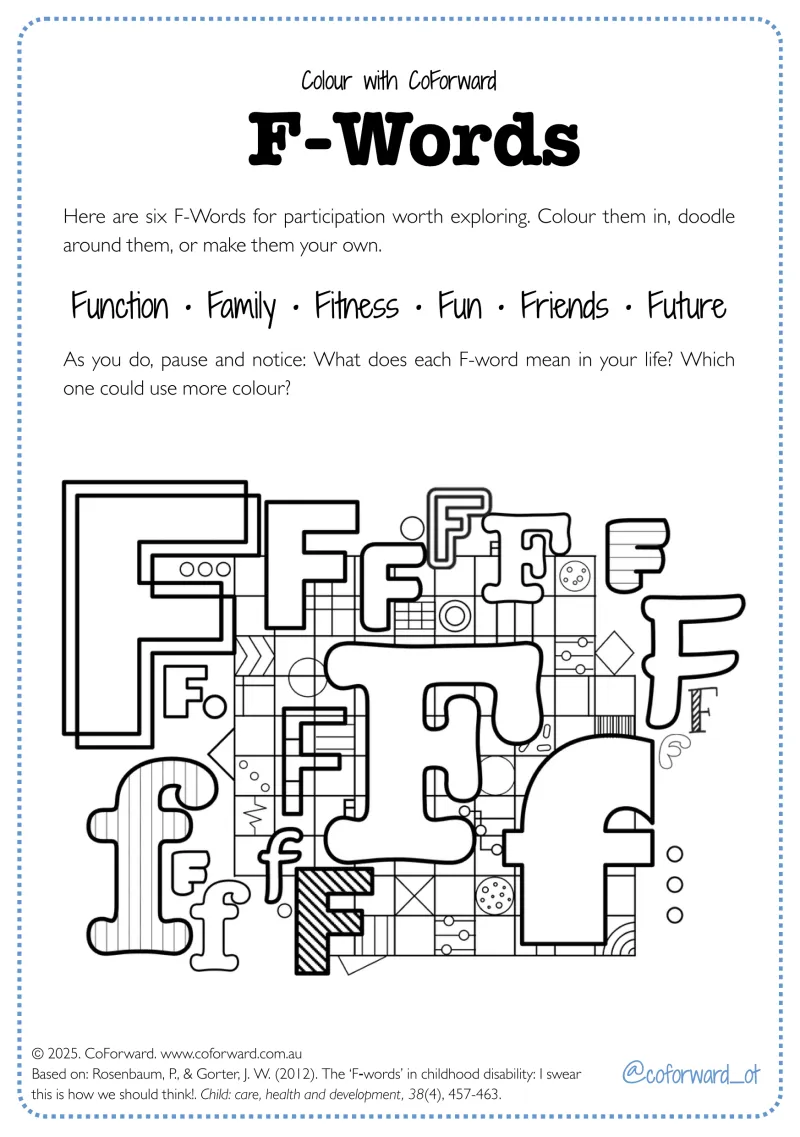
Download the printable F-Words colouring sheet (PDF)
References
Rosenbaum, P., & Gorter, J. W. (2012). The 'F-words' in childhood disability: I swear this is how we should think!. Child: care, health and development, 38(4), 457-463.
World Health Organization (2001). International Classification of Functioning, Disability and Health (ICF). World Health Organization, Geneva, Switzerland.